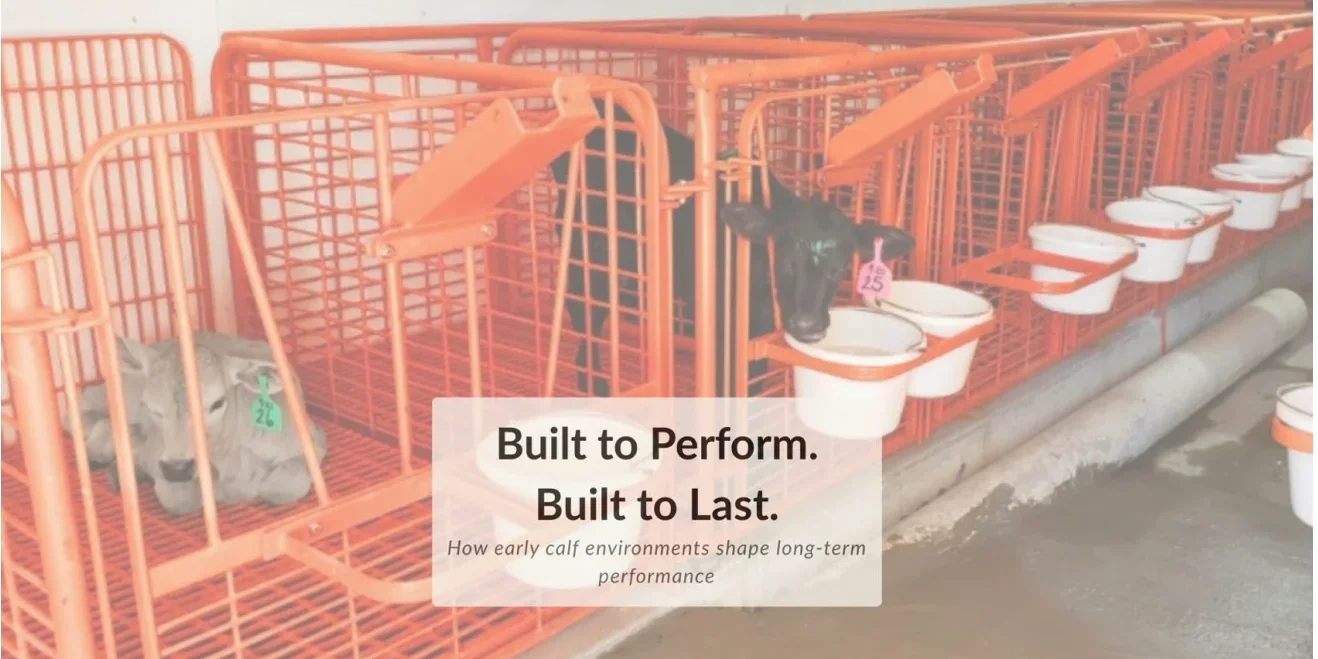
Part of the “Built to Perform. Built to Last.” series, exploring long-term performance in early calf environments.
The challenge with scaling calf care isn’t simply having more calves.
It’s having to get the same important things right more times.
A feeding routine that works for 20 calves has to work again at 50. A cleaning process has to remain practical across every additional housing space. Employees still need to notice the calf that isn’t quite acting like herself—even when there are more calves competing for their attention.
And every small inefficiency gets repeated, too.
The awkward latch. The extra trip for supplies. The corner that’s difficult to clean. The housing unit that requires a slightly different approach than all the others.
Once may not matter.
Fifty times might.
Scale doesn’t make consistency less important. It gives inconsistency more opportunities to multiply.
That makes one question increasingly important as calf programs grow:
How much good calf care can the system make easier to repeat?
The Hundredth-Repetition Test
Try a piece of equipment once, and almost anything can seem manageable.
Now imagine doing the same thing for the hundredth time.
That is a very different test.
Can employees still access the calf easily? Is the surface practical to clean? Does bedding require unnecessary movement? Are commonly used components where employees need them? Can someone move naturally from one calf space to the next?
Most importantly, does the system still make sense when employees are busy?
Daily calf care is built on repetition. Therefore, a design feature that saves one movement or removes one small frustration doesn’t provide that advantage once.
It provides it again and again.
At scale, the smallest design decisions can become some of the most repeated decisions on the farm.
Workarounds Don’t Scale Well
Every farm has workarounds.
You lift that latch a certain way. Approach this pen from the other side. Bring an extra tool because one component tends to stick. Clean that corner from a different angle.
With an experienced employee and a smaller system, those little adjustments may barely register.
Then the operation grows.
A new employee needs to learn the workaround. Someone covering a shift doesn’t know it. More housing creates more opportunities for the same inconvenience to appear.
Eventually, the workaround becomes part of the routine.
That’s worth paying attention to.
Because when equipment requires employees to compensate for its design, the farm isn’t simply using the system. Employees are completing an additional layer of work to make the system function for them.
Good design removes instructions that should never have been necessary.
Make the Right Action the Easy Action
Protocols create consistency on paper.
Design can help create it in practice.
If the preferred cleaning method requires employees to fight around difficult surfaces, consistency takes more effort. If checking a calf requires awkward access, observation becomes less convenient. When every housing space operates differently, employees have to remember those differences while completing routine work.
The opposite is also true.
Logical access, familiar components, practical surfaces, and predictable layouts can support the behaviour the operation already wants from employees.
This doesn’t replace training. Nor does it eliminate the need for good management.
Instead, the physical environment works with the protocol rather than against it.
The strongest systems don’t rely on employees overcoming the design to do the job well.
Decide What Should Be the Same—and What Shouldn’t
Consistency can easily be mistaken for sameness.
Calf care shouldn’t work that way.
The cleaning process can be standardized.
The equipment can operate consistently.
Employees can follow a predictable feeding workflow.
Access can remain familiar from one housing space to the next.
But the calf?
That is where individual attention matters.
One calf may finish feeding eagerly while another hesitates. One may be alert at a time when another appears quieter than usual. Bedding conditions, manure consistency, appetite, posture, and behaviour can provide information that requires a person to notice what is different.
This creates an important design goal:
Standardize the routine. Keep the observation individual.
The less attention employees have to give unnecessary variation in the system, the more attention they can give meaningful variation in the calves.
One Awkward Corner Becomes 100 Awkward Corners
Sanitation illustrates the scaling effect particularly well.
Imagine one surface takes slightly more effort to clean.
In a single calf space, the difference may seem insignificant.
Repeat that difficulty across an entire row of housing. Then repeat the cleaning process throughout the year.
Suddenly, a small design detail isn’t quite so small.
The same applies to surfaces that deteriorate, areas employees struggle to reach, or components that complicate cleaning.
Conversely, a cleanable surface provides its advantage every time employees sanitize it.
This is why design and materials become increasingly important as repetition increases. They influence not only whether employees can follow the sanitation protocol, but how practical it is to follow that protocol consistently across the entire system.
Consistency Can’t Live in One Employee’s Head
Experienced employees are enormously valuable.
They also tend to accumulate knowledge nobody wrote down.
They know which latch needs an extra push. Which calf space drains differently. Where to stand to make a particular job easier. Which component needs watching.
That knowledge can keep an imperfect system moving.
But what happens when that employee takes vacation?
Or change jobs?
Or someone else covers the weekend?
A scalable system should not require years of institutional knowledge simply to operate it effectively.
Training will always matter. Experience will always matter.
However, intuitive equipment, consistent layouts, and standardized components can reduce how much basic system knowledge employees have to carry in their heads.
Then experience can be used where it has more value: caring for calves.
Efficiency Should Create Attention, Not Remove It
There is a risk in any conversation about scale and efficiency.
Faster can become the goal.
But completing calf chores faster isn’t particularly valuable if employees stop noticing calves along the way.
The better goal is to remove unnecessary work while protecting meaningful attention.
If employees spend less time wrestling with equipment, retracing steps, or compensating for awkward design, some of that capacity can stay with the calf.
A pause to notice appetite.
An extra look at behaviour.
A bedding adjustment before it becomes a larger issue.
A calf that gets noticed because something simply seems different today.
The point of efficiency isn’t to move past calves faster. It’s to remove the things that compete with good calf care.
Don’t Build Today’s Workaround Into Tomorrow’s Expansion
Scaling doesn’t begin when a farm becomes “large.”
It begins whenever today’s system needs to accommodate tomorrow’s growth.
That might mean 20 more calves. Another row of housing. A second employee. A facility expansion. Or simply reorganizing an existing calf area.
Growth creates an opportunity to ask whether the current routine should actually be replicated.
Which parts work well enough to multiply?
Which frustrations would also multiply?
Can additional housing follow the same logical workflow?
Will employees use familiar components?
Can sanitation processes extend naturally to the new spaces?
Sometimes the best time to fix a workaround is before you build 50 more of it.
Design for the Day When Everything Is Busy
Perhaps the best test of a calf system isn’t how it performs on an ordinary day.
Think about the busy one.
Several calves need additional attention. Someone called in sick. The weather changed. Cleaning needs to happen. Feeding can’t wait. The list of other farm jobs hasn’t gotten any shorter.
Does the system make that day easier—or add to it?
No housing design can remove the unpredictability of raising calves. Nor can it guarantee consistency regardless of what happens around it.
But design can determine how much unnecessary complexity employees have to manage on top of everything else.
ADA’s “Built to Perform. Built to Last.” approach reflects that idea. Housing, flooring, equipment, materials, and layout can work together to support routines that remain practical as an operation changes and grows.
Because scaling calf care isn’t simply about doing more.
It’s about deciding what deserves to be repeated.
Build the right things into the system, and every repetition becomes an opportunity to reinforce them.
Explore calf stalls, calf flooring, and calf equipment at ADAENT.net.