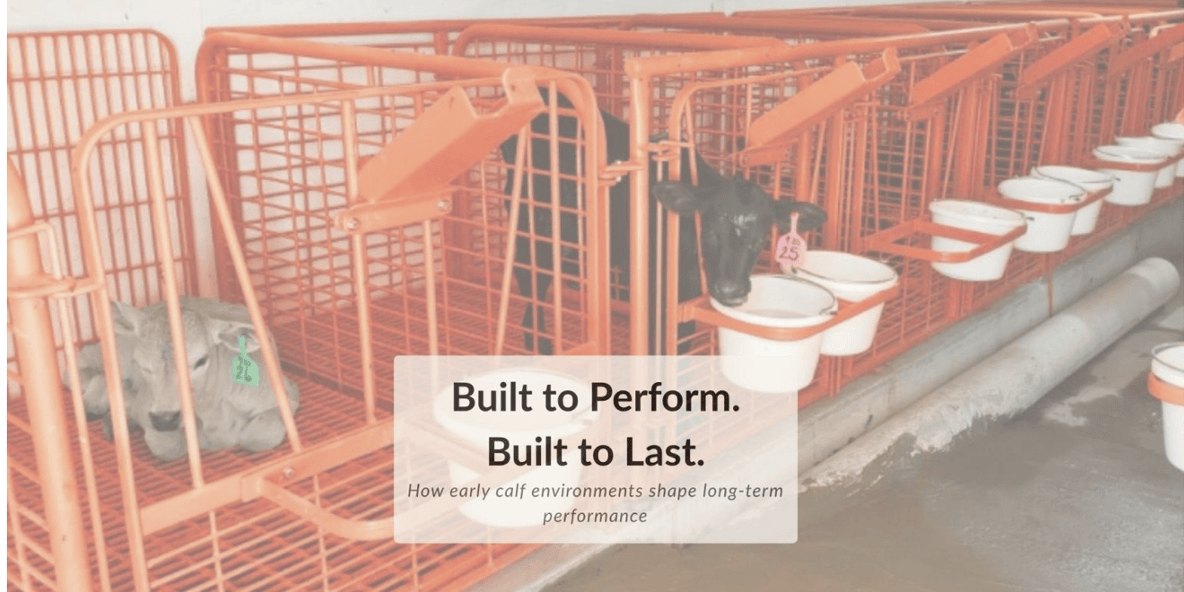
Part of the “Built to Perform. Built to Last.” series, exploring long-term performance in early calf environments.
The purchase price of a calf hutch is easy to calculate. The cost of working around a poorly designed system for years is much harder to see.
A hutch may look like a relatively simple piece of equipment. It provides shelter, creates an individual environment, and gives producers a practical way to house young calves.
But the hutch itself is only one part of the equation.
Every day, people move around it, clean it, bed it, feed calves within it, monitor health, and manage changing weather conditions. Those interactions turn individual pieces of equipment into something much larger: a calf management system.
What producers can underestimate is the cumulative effect of workflow, cleaning time, maintenance, airflow, access, and daily repetition. None of these factors may determine a housing decision alone. Together, however, they can determine how well the system performs.
The Details That Add Up
When producers evaluate calf housing, obvious factors naturally receive attention. Purchase price, durability, capacity, and available space all matter.
Yet some of the greatest long-term differences come from details that seem relatively small at first:
- How easily can employees access each calf?
- How long does cleaning take?
- Does the layout support efficient movement?
- Can bedding stay dry?
- Does the environment support adequate airflow?
- How well will materials withstand years of cleaning and exposure?
A few extra steps may seem insignificant during one feeding. An additional minute of cleaning may seem insignificant for one pen. Multiply those inefficiencies across calves, employees, chores, and years of use, and they become part of the true cost of the system.
The true performance of calf housing is often found in the work it either removes or creates.
Looking Beyond the Hutch
Traditional discussions around calf housing often focus on the individual unit. Yet calves experience much more than the walls around them.
They experience airflow, bedding conditions, surface cleanliness, moisture levels, and the consistency of daily care.
Employees experience another side of the same system. They navigate the layout, feed calves, clean equipment, manage bedding, observe health, and respond when something changes.
A strong calf environment needs to work for both.
Housing that meets a calf’s basic needs but creates unnecessary labor can make consistency harder to maintain. Likewise, an efficient workflow cannot compensate for an environment that makes sanitation, airflow, or calf observation difficult.
The strongest systems bring these priorities together.
Labor Reveals System Weaknesses
Labor often exposes inefficiencies that are easy to overlook during the initial housing decision.
An extra trip across a row, an awkward cleaning area, or equipment that requires repeated handling may seem minor. Repetition changes the equation.
As labor becomes tighter, systems that depend on extra steps become increasingly difficult to manage. Eventually, employees must decide where to spend limited time.
That does not necessarily indicate poor management. Instead, it can reveal a system that asks people to compensate for its design.
When housing reduces unnecessary movement and simplifies routine tasks, employees can direct more attention toward the calves themselves.
When the Environment Supports the Protocol
Good management protocols still depend on the environment where employees carry them out.
Cleaning provides a clear example. Smooth, durable surfaces support thorough sanitation, while good access helps employees reach areas where organic matter collects. Effective drainage and drying also prevent moisture from lingering between cleaning cycles.
Airflow follows the same principle. Pen placement, spacing, bedding conditions, and the surrounding environment all influence air movement at calf level.
In both cases, the system can either support the management goal or create another obstacle to achieving it.
Good systems do not replace good management. They make good management easier to repeat.
Durability Is More Than How Long Something Lasts
Producers often measure durability in years of service. However, longevity alone does not tell the whole story.
A more useful question is: how well does the system perform throughout those years?
A housing component may remain functional while gradually becoming harder to clean, maintain, or use efficiently. Corrosion, surface wear, damaged components, and repeated repairs can quietly increase labor and reduce consistency.
Therefore, long-term value depends on more than whether equipment remains usable. It depends on whether that equipment continues to support the job it was intended to do.
A system that performs consistently after years of daily use delivers a different kind of value than one that simply lasts.
Designing for the Day-to-Day
Producers rarely manage calves under perfect conditions.
Weather changes. Labor availability shifts. Calf numbers fluctuate. Disease pressure varies. Some days simply bring more challenges than others.
For that reason, successful calf systems cannot depend on ideal circumstances.
Simple workflows, durable materials, effective sanitation, consistent airflow, and easy calf access all help create resilience in daily management.
When these pieces work together, consistency requires less intervention. Instead of continually working around the environment, employees can follow a system designed around the realities of calf care.
A System Built to Perform
The shift from thinking about hutches to thinking about systems changes how producers evaluate calf housing.
Initial cost still matters. So do durability and capacity. However, the complete equation also includes labor, cleanability, airflow, maintenance, workflow, and the ability to deliver consistent care over time.
This system-based thinking aligns with the philosophy behind ADA’s “Built to Perform. Built to Last.” approach. Early calf environments should do more than provide housing. They should support the people, processes, and management practices that influence calf performance every day.
Evaluating calf housing as a system changes the questions producers ask, and often reveals costs and opportunities that are not visible in the initial purchase price.
The shift from hutches to systems begins when the question changes from simply, “How long will this housing last?” to “How well will it help us manage calves every day that it lasts?”
The strongest calf environments do not ask management to compensate for design. They support consistent care through the realities of daily use: one feeding, cleaning, bedding change, and calf at a time.
Explore calf stalls, calf flooring, and calf equipment at ADAENT.net