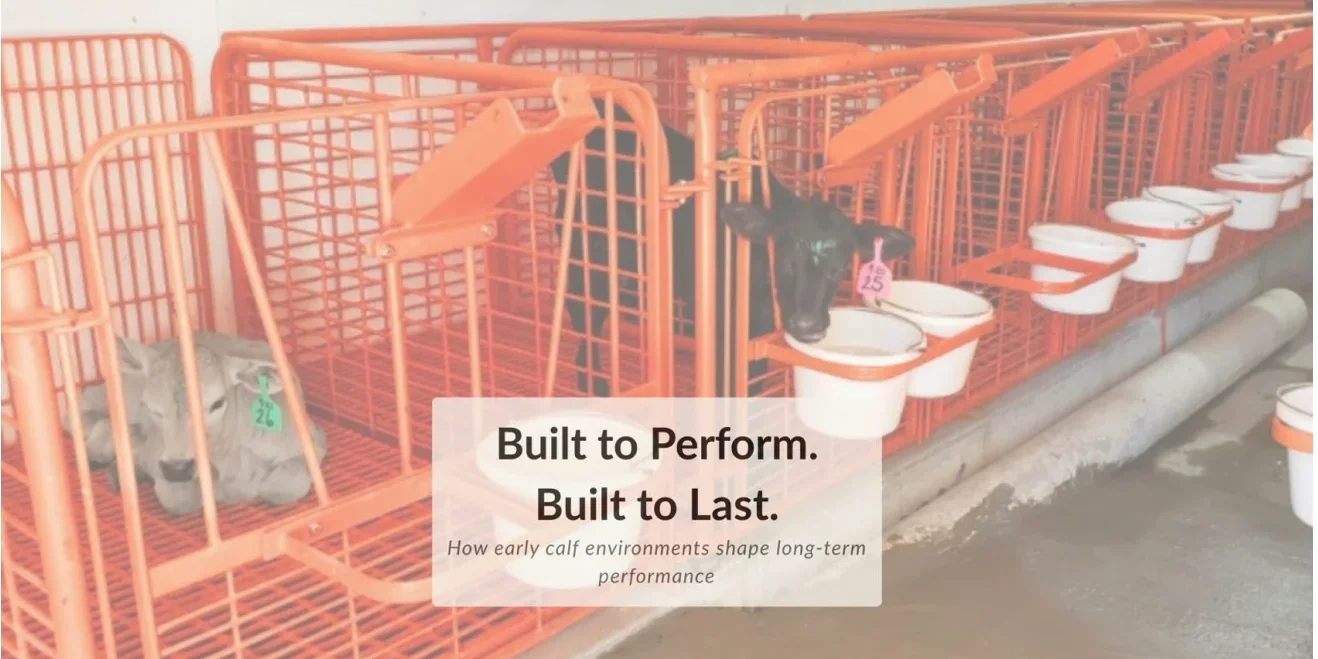
Part of the “Built to Perform. Built to Last.” series, exploring long-term performance in early calf environments.
Ask what a piece of calf equipment costs, and there is usually a number.
Ask how quickly it will pay for itself, and the answer gets more complicated.
That is where the sales pitch can creep in.
Save this many minutes. Avoid this many repairs. Keep it for this many years. Add those assumptions together, and almost any investment can be made to look good on paper.
Real farms are rarely that predictable.
Labor changes. Management changes. Weather happens. Equipment gets used differently from one operation to the next. And some of the most valuable returns never appear as a neat line on a spreadsheet.
So perhaps the better question isn’t, “When will this pay for itself?”
It is: “What should this investment give back to our operation?”
For calf housing, that answer may include time, durability, easier sanitation, fewer interruptions, better workflow, and equipment that continues to perform without demanding unnecessary attention.
There is no dramatic promise in that.
But there is a much more useful way to think about payback.
First, Define What You’re Trying to Fix
A return only matters if it solves a problem the farm actually has.
When employees spend too much time cleaning, cleanability has value.
Recurring repairs make durability more important. Meanwhile, unnecessary steps during feeding and bedding can increase the value of better workflow.
And when labour is stretched thin, minutes matter.
Yet two farms buying the exact same piece of equipment may not receive the same return from it because they didn’t necessarily need it for the same reason.
That makes the starting question surprisingly simple:
What problem are we paying to solve?
Once producers can answer that, evaluating payback becomes much more meaningful.
The Five-Minute Test
Imagine a change to the calf area saves an employee five minutes.
Is that enough to justify an investment?
Once? Probably not.
But what happens when the task occurs twice a day? Or when several employees perform it? Consider those five minutes disappearing from the routine every day for the next several years.
Now the question becomes more interesting.
As Article #9 of this series explored, small inefficiencies become operating costs through repetition. Fortunately, efficiencies work the same way.
Still, producers don’t need to turn every saved minute into a promised dollar amount.
The real return may be what that time allows employees to do next.
Check another calf. Refresh bedding. Complete another job. Spend a little longer observing an animal that doesn’t quite look right.
Efficiency doesn’t always mean doing less work. Sometimes it means having more time for the work that matters.
What Is a Problem Worth When It Stops Being a Problem?
This may be one of the hardest forms of payback to measure.
Maybe it’s a latch that no longer needs adjusting.
Perhaps employees no longer have to fight a surface to get it clean. A troublesome component may disappear from the repair list, while a better layout eliminates unnecessary steps.
Once a recurring frustration disappears, people have a tendency to stop thinking about it.
And that’s precisely the point.
When equipment works as intended, there may be no repair invoice, service call, lost time, or daily annoyance reminding the operation of its value.
Some returns are easiest to notice only after you stop paying for the problem they replaced.
The Repair That Doesn’t Happen Still Counts
Maintenance makes that idea especially clear.
When something breaks, the farm can usually identify at least some of the cost. There is a replacement part, employee time, perhaps a service call, and the inconvenience of working around the problem until someone fixes it.
Reliable equipment produces no equivalent receipt.
Nobody sends an invoice that says, “Here’s what you didn’t spend this year.”
Consequently, durability can be easy to undervalue.
No calf housing system is maintenance-free, nor should producers expect it to be. Farm environments put equipment through weather, animals, cleaning, bedding, and constant use.
However, frequency matters.
So does the amount of attention equipment requires to remain useful.
Over years of ownership, fewer interventions can represent a very real return—even if nobody can point to one dramatic moment when the equipment “paid for itself.”
Clean It Once—or Clean It Hundreds of Times?
Cleanability follows the same principle.
If employees only had to clean calf housing once, shaving a few minutes or making surfaces easier to access wouldn’t matter very much.
But they don’t clean it once.
They repeat the process throughout the life of the housing.
That changes the value of good design.
Accessible surfaces, durable materials, and practical layouts can make routine sanitation easier to complete. More importantly, that advantage returns every time employees clean the space.
The benefit compounds through repetition.
This is where the difference between a product feature and operational value becomes important.
A feature tells producers what something has.
Payback comes from what that feature changes during actual use.
Don’t Force the Math
This is where ROI discussions can lose credibility.
Not every benefit needs a dollar sign attached to it.
When farms have reliable numbers, use them. For example, if cleaning previously required a known amount of employee time and a new system measurably changes that, the farm can calculate the difference. Maintenance records, replacement histories, and service life can also provide useful comparisons.
But assumptions shouldn’t masquerade as savings.
A manufacturer cannot know exactly what five minutes is worth on every farm. Nor can anyone guarantee how many repairs a producer will avoid or assign a universal dollar value to a smoother workflow.
Instead, producers can use the numbers they actually know and ask practical questions about everything else.
Has the investment reduced the problem it was meant to solve?
Compared with the old system, is the job easier?
Consider how much attention the equipment now requires and whether it has held up as expected.
Producers can also look at whether the system supports the way employees actually work.
And perhaps most telling:
Knowing what we know now, would we buy it again?
That last question doesn’t require a complicated ROI formula.
It does require experience.
Payback Can Be Operational
Some returns appear clearly in the books. Others show up in how smoothly the day runs.
Consider the difference between a calf area where employees constantly compensate for equipment and one where the system largely stays out of their way.
Calves remain accessible. Chores follow a logical flow. Employees can manage cleaning efficiently, while components continue to function as expected. Meanwhile, maintenance doesn’t continually interrupt the routine.
None of those outcomes sounds particularly dramatic.
That is exactly why they matter.
Calf housing is working equipment. Producers and employees interact with it over and over, often for years.
Good equipment earns its value not only through what it does, but through what it doesn’t ask employees to compensate for.
The Most Useful ROI Conversation May Happen Years Later
Perhaps the fairest time to judge an investment isn’t the day it arrives.
It is several years later.
At that point, producers can look at whether the equipment is still doing what the farm bought it to do.
They can consider how well the surfaces have held up, how much maintenance the system has required, and whether the workflow still makes sense.
Cleanability matters, too. So does the amount of modifying, repairing, or working around the system has required over time.
Then comes perhaps the simplest question of all: Would the farm choose it again?
Together, those questions reveal something a sales brochure never can: how the investment performed in the real world.
ADA’s “Built to Perform. Built to Last.” approach reflects that longer view. The value of calf housing develops through the routines, cleaning cycles, seasons, repairs, and years that follow the initial purchase.
So, does good calf housing pay for itself?
There isn’t one honest answer that applies to every farm.
There is, however, a better question.
Years from now, will you still be glad you bought it?
That may be the most meaningful payback calculation of all.
Explore calf stalls, calf flooring, and calf equipment at ADAENT.net