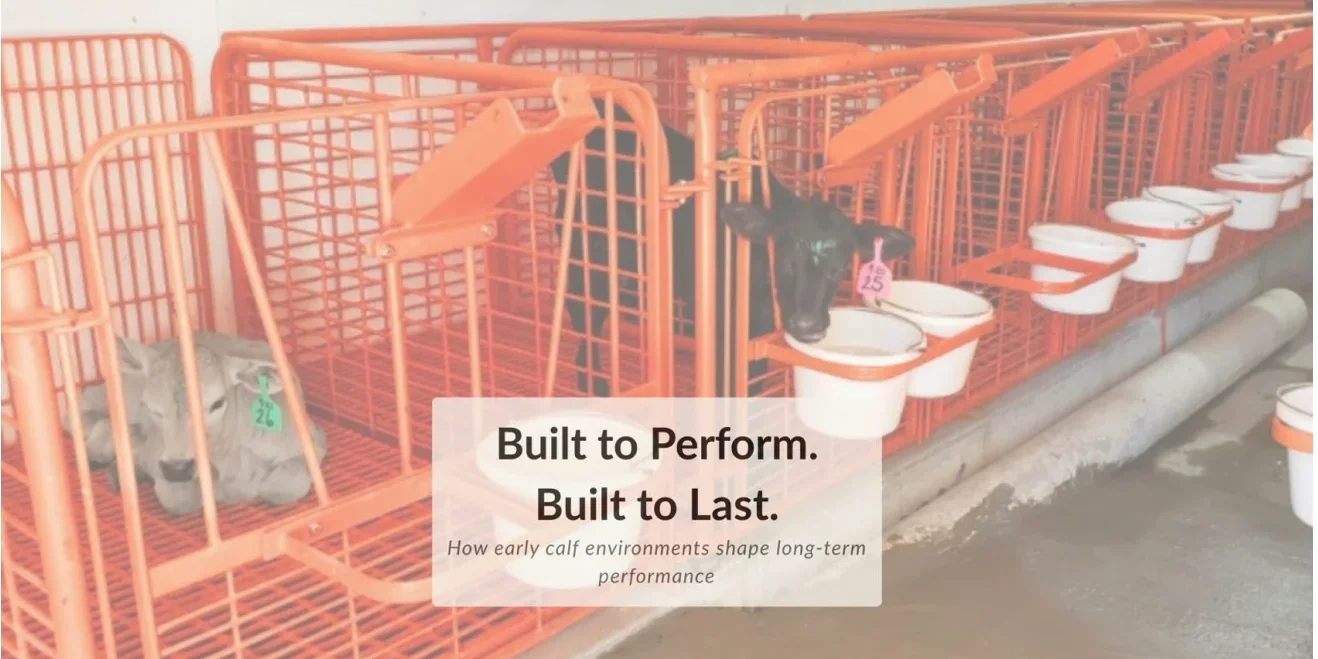
Part of the “Built to Perform. Built to Last.” series, exploring long-term performance in early calf environments.
Two calf housing systems can sit side by side on a quote, and the less expensive option is easy to identify.
What the quote cannot show is what happens next.
It doesn’t show the extra minutes spent cleaning a difficult surface. Nor does it account for a latch that needs repeated adjustment, a panel that deteriorates sooner than expected, or a layout that adds unnecessary steps to feeding and bedding. Five years later, one system may still support the daily routine while another requires more attention.
Those costs arrive later. Often, they accumulate so gradually that they simply become part of doing the job.
That is what makes “cheaper” difficult to define.
The price of calf housing is paid once. The cost of using it is paid every day.
For producers comparing housing options, looking at both can create a very different picture of value.
Start With the Costs You Can’t See on the Quote
Purchase price matters. Every farm has a budget, and investments in calf housing compete with priorities across the operation.
However, the initial price is only one part of what producers eventually pay.
Housing becomes part of the daily routine for years. Employees feed around it, add bedding, clean surfaces, inspect components, complete maintenance, and depend on the system through changing weather and repeated use.
As a result, housing creates costs that are harder to capture upfront.
How much time will employees spend cleaning between calves? What maintenance will the system require? How easily can the team repair or replace worn components? Will surfaces remain practical to sanitize? Does the layout simplify chores or add steps to them? Finally, how long can producers reasonably expect the system to perform as intended?
Individually, those questions may seem secondary to the number on the quote.
Over several years, however, they become part of the price.
Five Minutes Doesn’t Stay Five Minutes
Some of the most expensive inefficiencies on a farm may not look expensive at all.
Consider a housing feature that adds only five minutes to a cleaning routine. On one occasion, five minutes is insignificant.
Repeat it across multiple hutches, every turnover, month after month, and those minutes become hours of labour.
The same principle applies throughout the calf area.
For example, a few additional steps at feeding can add time. So can reaching an awkward area during cleaning or regularly adjusting a troublesome component. Likewise, an unexpected repair can interrupt the normal routine.
No single event is likely to change the economics of a calf program. Over time, though, repetition can.
In a job performed hundreds or thousands of times, small inefficiencies have a way of becoming operating costs.
For that reason, producers should evaluate housing through the routine it creates, not simply the structure they purchase.
Durability Is More Than Still Standing
Housing can technically remain in service without continuing to perform as well as it did when it was new.
That distinction matters.
Over time, weather, cleaning, bedding, animal contact, and daily use can affect surfaces, hardware, panels, and other components. Consequently, a system may still function while requiring more repairs, cleaning effort, or employee attention.
Useful life, therefore, involves more than asking, How many years will this last?
It is also worth asking, How well will it work during those years?
Long life creates value when performance lasts with it.
Materials, construction, repairability, corrosion resistance, and cleanability all contribute to that equation. Ultimately, the goal isn’t simply equipment that survives years of use. It is housing that continues to support the work producers need it to do.
Cleaning Time Is Labor Time
Sanitation provides one of the clearest examples of how design becomes an operating cost.
Every calf space requires cleaning. The difference is how much effort the housing requires to do the job well.
For instance, smooth, accessible, durable surfaces can support an efficient cleaning process. In contrast, damaged surfaces, difficult-to-reach areas, or materials that become harder to clean with age can add time to each turnover.
The sanitation protocol hasn’t changed, but the amount of work required to complete it has.
That distinction becomes particularly important when labour is limited. Time spent compensating for equipment or design is time employees cannot spend observing calves, maintaining bedding, managing nutrition, or completing other work on the farm.
Efficiency, therefore, isn’t simply about getting chores done faster. It is also about allowing employees to focus their time where it provides the greatest value.
Maintenance Has More Than a Parts Cost
A broken or worn component has an obvious cost: the replacement part.
However, the less obvious costs happen around it.
Someone has to identify the problem, find or order the part, make the repair, and potentially work around the issue until the team resolves it. If a larger component or housing unit needs replacement, the disruption can extend further.
Of course, virtually any farm equipment will require occasional maintenance.
The more useful question is what that maintenance will look like over the expected life of the housing.
For example, a lower initial investment that requires frequent attention may eventually narrow the gap between it and an option with a higher purchase price. In other situations, the lower-cost system may perform exactly as the farm needs it to.
Either way, price alone cannot answer the value question.
Put the Numbers on the Same Timeline
A more useful comparison begins when producers put upfront and long-term costs on the same timeline.
Consider:
- initial purchase and installation
- expected service life
- routine cleaning and labour requirements
- anticipated maintenance and replacement components
- ease of repair
- durability of surfaces and materials
- workflow over the life of the system
- the cost and disruption of eventual replacement
Not every factor needs an exact dollar amount to improve a purchasing decision.
Sometimes, simply asking the questions exposes differences that aren’t visible on the original quote.
For example, a system that costs more initially but requires less intervention over a longer service life may make economic sense. Alternatively, a less expensive system that meets the operation’s needs without creating additional work may also represent excellent value.
The point isn’t that one price category is automatically better.
Instead, purchase price and cost of ownership are two different measurements.
The Right Equation Will Look Different on Every Farm
There is no universal answer to what calf housing should cost.
A large operation with tight labour availability may put significant value on shaving minutes from repeated chores. Meanwhile, a smaller farm may prioritize flexibility or ease of repair. Climate, herd size, facility layout, management style, expansion plans, and available capital can also change the calculation.
Those differences are exactly why “cheaper” deserves a closer look.
Rather than asking only which option costs less today, producers can consider which option makes the most sense for the way their farm will actually use it.
What will employees do around this housing every day?
What is likely to wear first?
How much effort will it take to keep the system clean?
How easily can employees maintain it?
And after years of use, what will the original purchase price have actually bought?
Look Past Day One
Calf housing is not purchased for day one. It is purchased for all the days that follow.
As a result, value becomes a long-term calculation.
ADA’s “Built to Perform. Built to Last.” approach reflects that broader view of early calf environments. Durability, cleanability, workflow, maintenance, and daily performance all contribute to what a housing investment ultimately costs—and what it delivers over its useful life.
For producers, the goal doesn’t have to be finding the cheapest system or the most expensive one.
Instead, it is about understanding what you’re paying for.
Because the number on the quote tells you what calf housing costs to buy. The years that follow tell you what it costs to own.
Explore calf stalls, calf flooring, and calf equipment at ADAENT.net