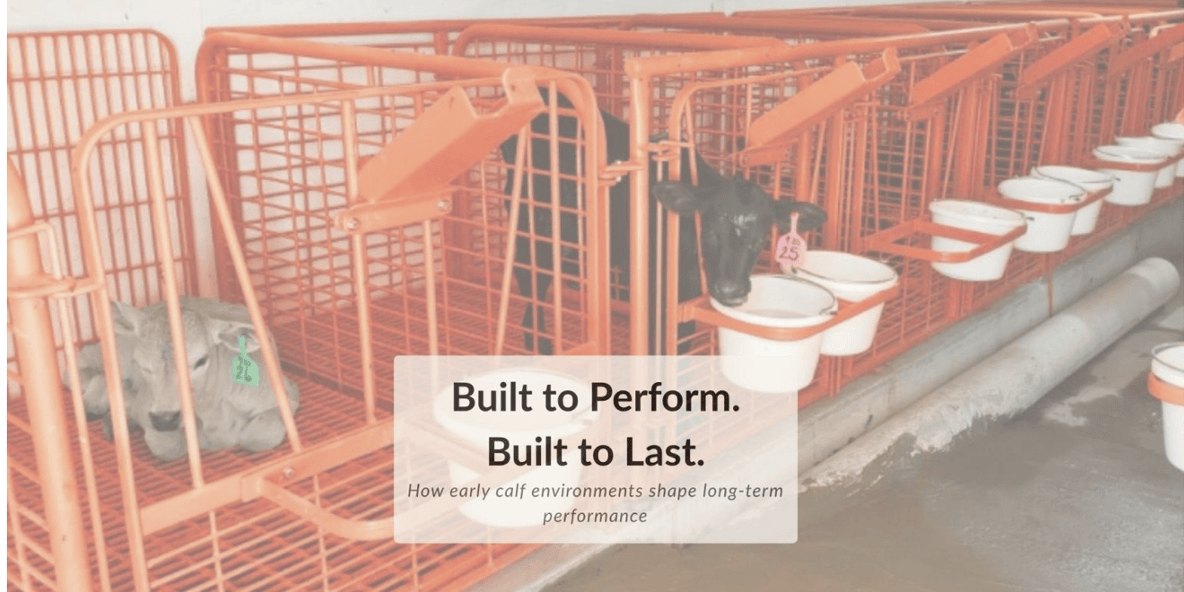
Part of the “Built to Perform. Built to Last.” series, exploring long-term performance in early calf environments.
Unlike sanitation or feeding protocols, air quality in the calf barn is not always visible—but its impact is constant. It influences calf health every hour of the day, whether it’s being actively managed or not.
Air moves through every part of a calf’s environment, carrying moisture, dust, bacteria, and gases. When managed well, it removes contaminants and supports a stable, healthy space. However, when airflow is inconsistent, those same elements begin to accumulate.
In early life, when the immune system is still developing, that difference matters.
Why Ammonia Matters
Ammonia forms naturally as manure and urine break down. In enclosed or poorly ventilated environments, it can build quickly.
Even at relatively low levels, ammonia irritates the respiratory tract and reduces the calf’s ability to defend against everyday exposure.
Air quality doesn’t just influence calf health—it shapes how hard the immune system has to work every day.
As a result, the immune system must work harder to respond to routine exposure. Over time, this added stress increases the risk of respiratory issues and reduces overall resilience.
Air Quality and the Immune Response
Calves rely on a developing immune system to navigate early-life challenges. While colostrum provides critical passive immunity, the environment determines how much pressure that system must handle.
Poor air quality increases that pressure.
Dust, moisture, and airborne pathogens create constant exposure. When ammonia is also present, natural defense mechanisms become less effective. Together, these factors weaken the immune response—even when no single issue appears severe.
In many cases, the problem is not one major failure. It is the accumulation of small, consistent stressors.
Where Airflow Breaks Down
So where do these challenges begin?
Most operations recognize the importance of ventilation. However, achieving consistent airflow is not always straightforward.
Airflow depends on how the entire environment functions.
- Dead air spaces allow contaminants to settle
- Poor layout limits movement at calf level
- Inconsistent ventilation creates pockets of humidity
- Seasonal changes shift airflow patterns
As a result, airflow becomes uneven. Some areas remain fresh and dry, while others trap moisture and gases.
In many barns, these issues are not obvious until calves begin to show inconsistent performance or increased respiratory challenges.
As with sanitation, inconsistency becomes the real challenge.
Ventilation as a System
Ventilation is often treated as a feature. In reality, it functions as part of a larger system.
Like sanitation and material selection, airflow is not a standalone feature—it is part of a system that must work consistently under daily pressure.
Air exchange, moisture control, pen layout, and material choice all influence how air moves through a space. Wet surfaces increase humidity. Poor drainage allows moisture to persist. Materials that hold moisture can further limit air quality over time.
Because of this, ventilation cannot be separated from the broader environment. It must work in combination with it.
Labor and Consistency
Maintaining air quality requires consistent management. However, like sanitation, it is influenced by time and labor.
On many operations, calf care tasks compete throughout the day. When systems are difficult to manage, adjustments to ventilation, bedding, and airflow may be delayed or missed.
Over time, these small gaps begin to affect air quality—and ultimately calf health.
The Cost of Compromised Air Quality
The impact of poor air quality rarely appears all at once. Instead, it builds gradually.
- Increased respiratory challenges
- Slower growth
- Greater variability between calves
- Higher treatment rates
Because these outcomes develop over time, they are often attributed to multiple factors. However, air quality frequently plays a central role.
As with sanitation and materials, the cost lies in the accumulation of small inefficiencies that affect long-term performance.
Designing for Air Quality
Improving air quality is not just about adding ventilation. It is about designing environments that support consistent airflow under real-world conditions.
This includes:
- Layouts that allow even air movement
- Materials that do not trap moisture
- Systems that support drainage and dryness
- Designs that adapt to seasonal change
When these elements align, the environment begins to support consistency rather than rely on constant correction.
A System Built to Perform
Across the industry, producers recognize that calf health depends on more than individual practices. Air quality, sanitation, materials, and design all work together to shape daily outcomes.
A system-based approach brings these elements together. When airflow is consistent and moisture is controlled, disease pressure becomes easier to manage.
This thinking aligns with the philosophy behind ADA Enterprises. Through the “Built to Perform. Built to Last.” approach, early calf environments are designed to support long-term performance—not only through durability, but by enabling consistent air quality, efficient management, and reliable outcomes under real-world conditions—where small environmental differences can have a measurable impact on calf health.
Air quality may not be visible. However, it is one of the most influential factors in early calf development.
When it is managed well, it supports immune function, reduces disease pressure, and improves consistency across groups. When it is overlooked, it quietly works against those same goals.
In early calf environments, what calves breathe matters as much as what they consume.
As expectations continue to rise, the operations that succeed will be the ones where air quality is not treated as an afterthought—but built into the system from the start.
Explore ADA’s calf flooring and calf stall systems designed for consistent, healthy environments—or request a sample to see the difference.